
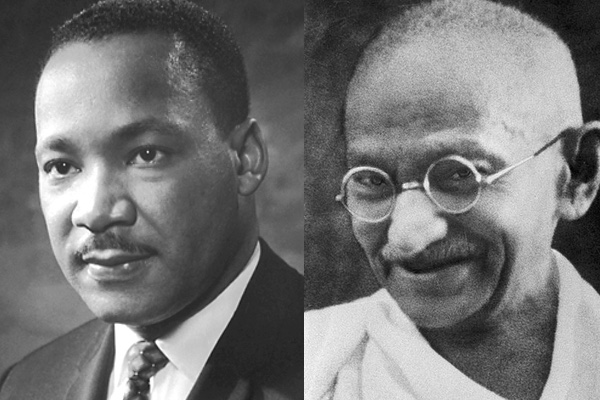
I am posting this shortly before Dr. Martin Luther King, Jr.’s birthday. I also realized that it was 40 years ago this month that I had the great good fortune to take a seminar on Mahatma Gandhi at Harvard Divinity School, taught by Professors Diana Eck, Lakshmi Jain, and Devaki Jain. The Jains, who were visiting professors that year, had “walked with Gandhi” and dedicated their lives to applying his teachings in modern India.
I was so lucky to study with them, and the concepts of nonviolent resistance are woven into my consciousness. Dr. King drew from the lessons of Gandhi when preaching and organizing for civil rights in the US. How do we apply those same concepts to interpersonal conflict?
When we conflict with someone, it is easy to see things as black and white, or either/or. To think that everything that person does is bad, or disagreeable. The more we think this way, the more polarized we become – until that person whom we once loved becomes our enemy. You no longer try to see things from their perspective, give them the benefit of the doubt. It is easy to fall into the trap of seeing them two-dimensionally.
Dr. King wrote about loving your enemies:
There is some good in the worst of us and some evil in the best of us. When we discover this, we are less prone to hate our enemies. When we look beneath the surface, beneath the impulsive evil deed, we see within our enemy-neighbor a measure of goodness and know that the viciousness and evilness of his acts are not quite representative of all that he is.*
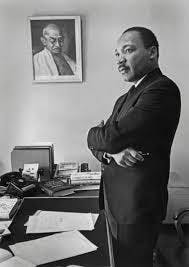
Bob Fitch photography archive, (c) Stanford University Libraries
Once we remember that the person we’re in conflict with has doubts fears and insecurities (and, perhaps, past traumas), we can treat them with dignity and hope that they will respond in kind, rising to the occasion. This doesn’t always work, I’m sure, but at least it is a start.
This is both/and thinking. To see what is good in them does not excuse the hurt they cause. It is complicated to see them as whole people, but we must.
Gandhi and King taught their followers to act with integrity, even when it put them in danger, and when it didn’t always move those in power. When we treat others with dignity, we bestow dignity on ourselves.
I leave you with that thought on this year’s MLK day – and welcome your thoughts, as well.